When size meets precision: Wüstwillenroth in the EU Project REED
Precision on a large scale: Maschinenfabrik Wüstwillenroth GmbH in the EU Project REED
Manufacturing large components with a high degree of precision, efficiency, and reliability presents particular challenges for machines and production processes. High workpiece weights, large dimensions, and complex machining operations are combined with increasing demands for quality, flexibility, and sustainability.
This is exactly where the European research project REED comes in. Together with European partners, Maschinenfabrik Wüstwillenroth is working on developing new digital solutions for the manufacturing of large and complex components and testing them under real-world conditions.
REED stands for “REsponsive and REconfigurable value network for the manufacture of bulky parts.” One of the project’s objectives, which runs until the end of 2027, is to develop a digital Manufacturing-as-a-Service (MaaS) platform. This will enable production capacities, machines, technologies, and services to be connected more flexibly in the future.
A practical application from industry
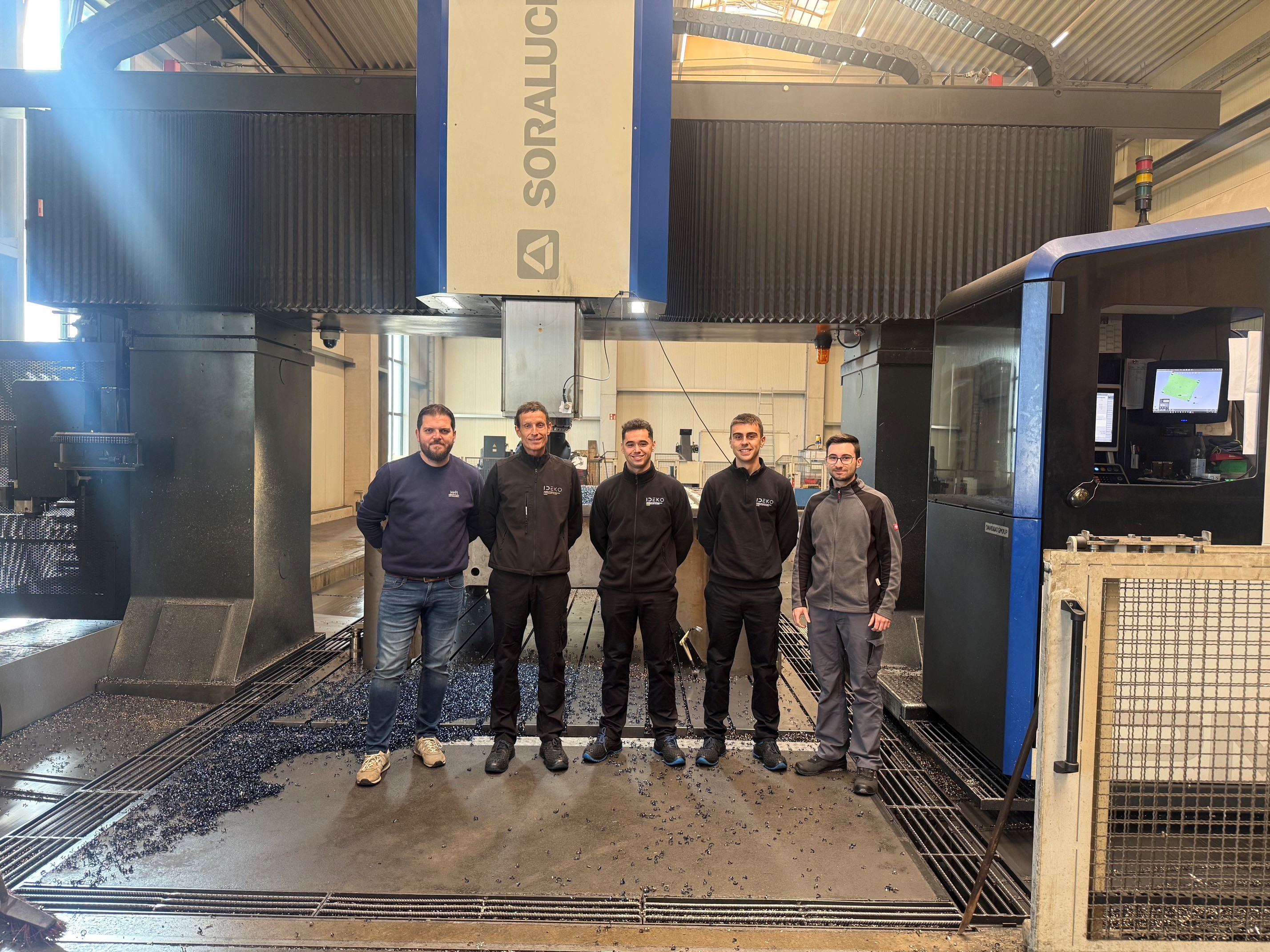
Wüstwillenroth plays a central role as the lead partner of the Metal Forming Machinery demonstrator. The focus is on a component for a deburring machine used in automotive applications, demonstrating how the solutions developed within REED can be applied to demanding manufacturing processes in the automotive sector.
The requirements are demanding: The machine has dimensions of approximately 4,000 × 3,000 millimetres, while the component itself requires dimensional accuracies of up to ±0.01 millimetres. High mechanical loads and potential vibrations during machining make the manufacturing process even more challenging.
One of the key questions addressed by the project is therefore: How can machine and process data be used to detect deviations at an early stage and continuously ensure manufacturing quality?
To achieve this, REED is investigating technologies including real-time monitoring, digital twins, and artificial intelligence. For example, real-time monitoring can continuously capture relevant machine and process parameters, while a digital twin can provide a virtual representation of the machine or manufacturing process. AI-based methods can then help identify patterns or deviations in the collected data that might otherwise remain unnoticed. In this way, REED aims to make production processes more transparent and easier to control, enabling deviations to be detected at an early stage and helping to reduce rework and scrap.
Where research meets industrial practice
For Wüstwillenroth, REED is above all an opportunity to combine its own expertise in manufacturing large and highly precise components with the knowledge and experience of European research and industry partners.
Digital technologies should not be an end in themselves. What matters is that they deliver tangible benefits in production: greater process reliability, increased efficiency, and more flexible manufacturing.
Until the end of 2027, Wüstwillenroth will actively contribute to the development and testing of the solutions. In this way, innovation takes place where research and industrial practice come together – with the aim of making the manufacturing of large components fit for the future.
Autors: Jean-Pierre Heineck, Pauls Reimer (WWR)